

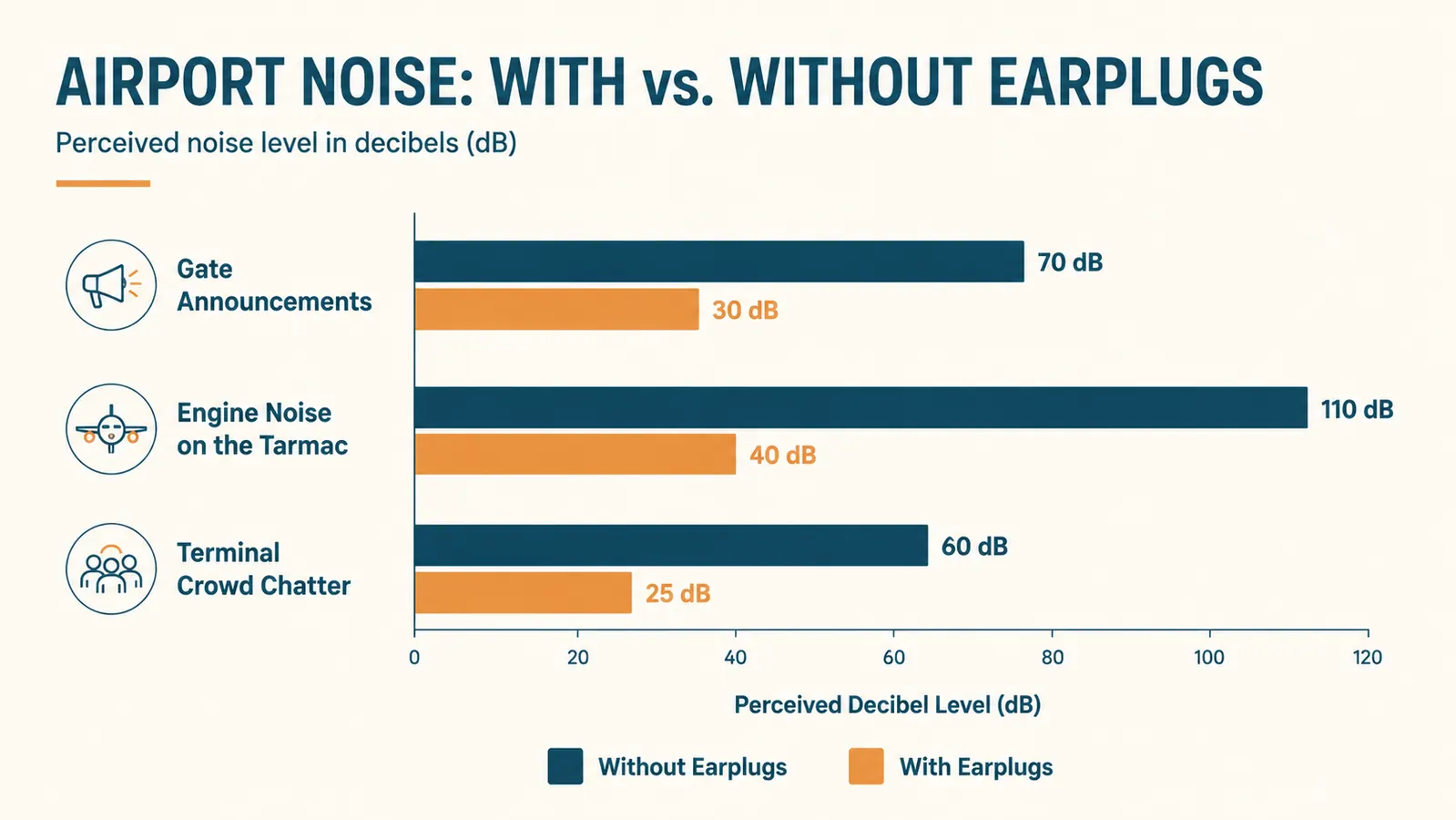
Airport noise is its own kind of exhausting, and it is not the same problem as airplane noise. A plane cabin has one steady drone you can mostly tune out. A terminal has a boarding announcement that spikes without warning every ninety seconds, a floor buffer running two gates down, a toddler losing it near the charging station, and a gate agent testing the PA system at full volume right as you finally doze off. I used to think noise-canceling headphones solved this until I spent a five-hour overnight layover in Denver with dead batteries and a dying phone, and realized the only thing that actually worked in that terminal was a pair of Mack's Pillow Soft Silicone Earplugs I'd tossed in my dopp kit as an afterthought. They are not headphones and they do not need a charge. They are soft moldable putty that seals against the outside of your ear canal, and once I started carrying them every trip, layovers stopped being something I white-knuckled through awake.
This is the exact routine I use now, five steps, from picking the right kind of plug for a terminal environment to knowing when to actually take them back out. None of it requires special gear beyond the plugs themselves and a couple minutes of setup, but the order matters. Skip a step and you either can't hear your boarding call or you can't get the plugs to seal in the first place, and either failure means you're back to sitting there wide awake while a gate agent announces zone four for the third time. I built this routine after enough bad layovers in Charlotte and Denver that I finally sat down and figured out what actually worked, instead of just grabbing whatever earplugs were cheapest at the newsstand kiosk.
Stop Losing Layovers to Gate Announcements
Mack's Pillow Soft Silicone Earplugs seal against the outside of your ear instead of jamming into the canal, so they mute the sharp stuff, PA blasts, floor cleaners, crying kids, without cutting you off completely. Check today's price on Amazon before your next long layover.
Amazon Check Today's Price on Amazon →Step 1: Choose Moldable Silicone Over Foam for Terminal Noise
Foam earplugs are built for one job, blocking a steady, continuous sound like engine drone or a snoring roommate. They work by expanding inside your ear canal, which takes a solid twenty to thirty seconds of rolling and holding before they actually seal, and they only really shine against consistent noise. Airport terminals are not consistent. They're spiky, unpredictable bursts, an announcement, a cart alarm, a stroller wheel dragging across tile, and foam's slow expansion doesn't handle sudden noise nearly as well as a putty that already has a firm seal in place before the sound even happens.
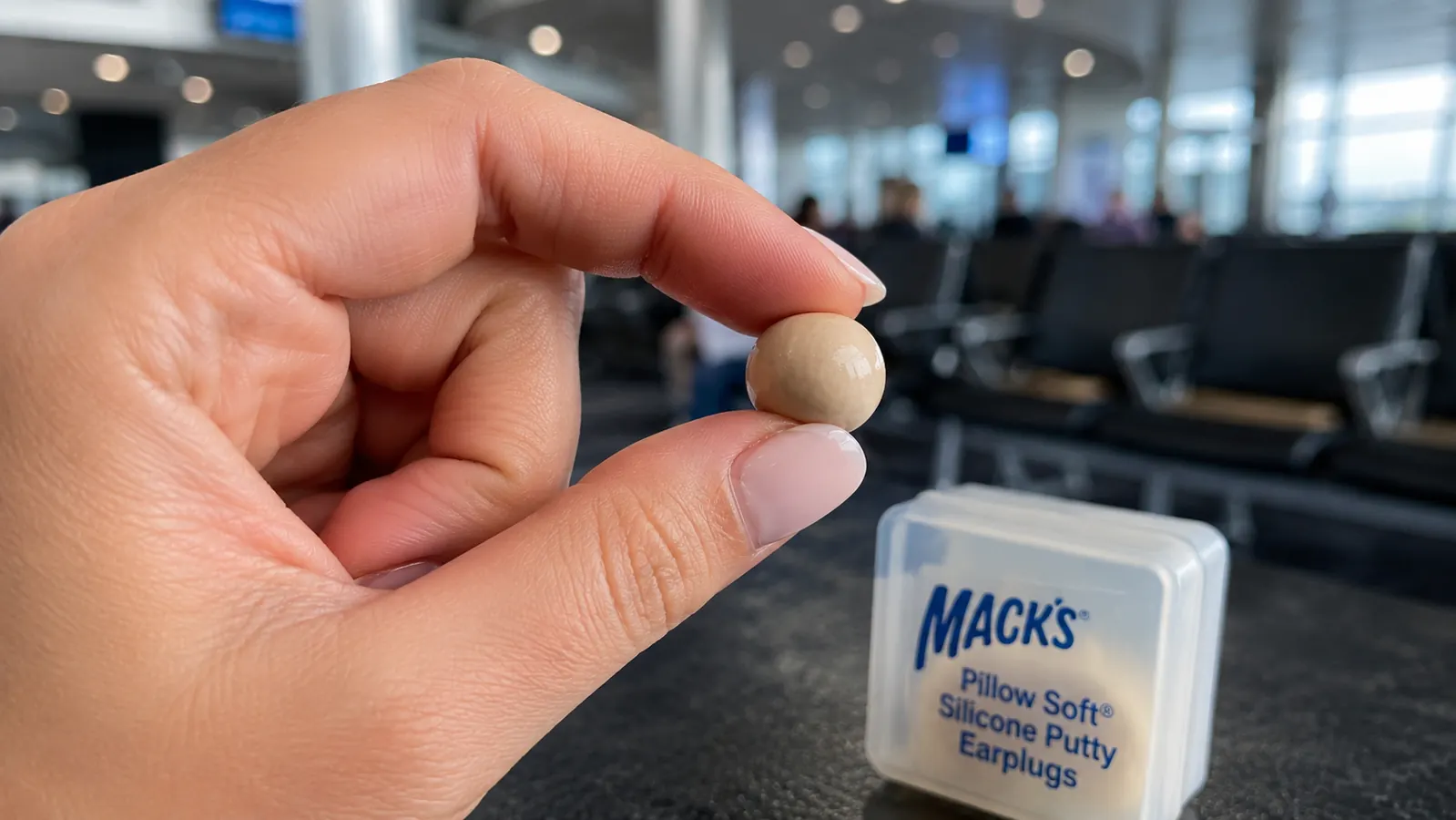
Mack's Pillow Soft works differently because it's not inserted into the canal at all. You warm a small ball of the silicone putty and press it over the outer opening of your ear, so it forms an external dome instead of plugging the canal itself. That matters two ways in a terminal. First, it seals faster and more reliably against irregular ear shapes, which is most of us. Second, it's genuinely more comfortable lying against a headrest or an airport chair's high back, since there's nothing pushing back out of your ear canal the way an inserted foam plug can when you turn your head.
The other reason I switched is reuse. A pack gives you twelve pairs, and each pair holds up for several uses if you keep them clean, which means one box realistically covers a full year of frequent travel instead of a crumbling single-use foam plug you toss after one red-eye. For anyone who flies more than a couple times a year, that math works out fast.
Step 2: Warm and Roll the Putty Before You Need It
Don't wait until your row is already boarding to fish a pair out of the package. Pull them out ten minutes before you actually want them in, roll a small piece between your palms or your fingers for about fifteen seconds, and let your body heat soften it. Cold silicone putty is stiff and doesn't seal well. Warm putty molds around the contours of your ear the way a good wax seal takes an impression, which is really the whole trick to why this style works better than foam in a chaotic environment.
I roll mine into a small ball roughly the size of a chickpea, slightly smaller than what the package photo shows, since a lump that's too large won't sit flush and leaves gaps at the edges where sound leaks straight through. Too little and you don't get full coverage over the canal opening. It took me two or three tries on my first trip to find the right amount, and now it's automatic, maybe ten seconds of adjustment once it's already pressed in place.
One thing I learned the hard way: don't roll it with lotion or hand sanitizer still wet on your fingers. The putty won't hold its shape and slides around instead of tacking down. Dry hands, warm putty, roll it once, and you're ready for step three.
Step 3: Seal the Dome, Don't Push It Inward
This is the step most people get wrong the first time they try a putty-style plug, because every other earplug they've ever used gets pushed into the canal. With Mack's, you press the rolled ball flat against the outer ear opening and smooth the edges outward, more like sealing a lid than inserting a plug. You're building a soft dome that covers the entrance without actually going inside.
Run a fingertip around the outer edge of the dome after you've pressed it in place and gently smooth down any spots that look thin or gapped. Those are the leak points where terminal noise sneaks through, and they're easy to miss on the first pass since you can't see your own ear while you're doing this. I check by cupping a hand near my ear and listening for a change in pitch. If a gate announcement still sounds sharp and clear instead of muffled and distant, there's a gap somewhere along the edge.
Once it's sealed right, it stays sealed even if you shift positions, lean your head against a wall, or fall asleep slumped sideways in a gate chair, which is the actual test. Foam plugs have a habit of working loose the moment you move your jaw or roll your head. A properly smoothed silicone dome holds its shape and its seal through all of that.

Step 4: Leave One Plug Loose Enough to Hear Your Name
Full silence sounds appealing until you realize you've missed a gate change or a name call for standby. I don't fully seal both ears during a long layover. I seal one side completely and leave the other slightly less pressed down, enough to mute the sharpest edges of terminal noise but still catch a PA announcement or someone saying my name at the counter. It's a small tradeoff, and it means I've never slept through a boarding call in three years of using these regularly.
If I'm napping somewhere I trust, an airline lounge with a display board I can glance at, or a gate area where I've already confirmed my flight isn't delayed, I'll seal both sides fully and set a phone alarm instead. But for a standard layover in a crowded terminal, the one-ear-loose approach has been the difference between actually resting and lying there anxious about missing my flight.
This is also where I'll layer in a phone alarm regardless of which approach I use, thirty minutes before boarding starts, set to vibrate against my leg in a pocket rather than a sound I'd need to hear through the plugs anyway. Belt and suspenders, but it works.
Step 5: Store and Reuse Them Right Between Flights
Each pair in the Mack's twelve-pack is meant to be reused a handful of times before you retire it, not thrown away after one nap. Between uses, I press the putty back into a rough ball shape and drop it into the small case that comes with the pack, then wipe my hands and check it for any grit or lint before the next use. Airport surfaces are not clean, and a plug that's picked up debris from a tray table or a jacket pocket won't seal as well and isn't something you want against your ear anyway.
I keep two or three fresh pairs in the outside pocket of my personal item, separate from the ones I've already used that trip, so I'm never digging through a used pair when I need a clean set for a different leg of a multi-flight day. A pack of twelve sounds like overkill until you're three connections deep on a trip and genuinely grateful you don't have to reuse the same worn-down ball from six hours earlier.
When a pair starts losing its stretch, gets visibly dirty, or won't hold a dome shape anymore no matter how much you roll it, that's the sign to retire it. I usually get four or five solid uses out of one pair before that happens, which stretches a single pack across a full year of regular travel for me.
What Else Helps
Earplugs handle the sharp, unpredictable noise a terminal throws at you, but a few other habits round out the routine. I pick gate seating away from the PA speaker mounted on the ceiling whenever there's a choice, since sitting directly under one means even a sealed plug still catches some of the volume. I also glance at the departure board before I settle in and confirm my gate hasn't changed, so I'm not relying purely on hearing an announcement through a partially sealed ear.
If I know I'll want to actually sleep rather than just rest, I pair the earplugs with a contoured eye mask, since light and sound are the two things keeping most travelers awake in a bright terminal, and solving only one of them leaves the job half done. I've also started asking gate agents directly whether my flight is running on time before I settle in for a nap, which sounds obvious but saves me from startling awake every time I hear footsteps near the counter. None of these extra habits replace the earplugs, they just close the small gaps a pair of plugs alone can't cover in a terminal that never really goes quiet.
The plugs don't need to block everything. They just need to smooth out the noise sharp enough to jolt you awake, and leave enough through to catch the one announcement that actually matters.
Turn Your Next Layover Into Actual Rest
If you've ever jolted awake to a gate announcement three rows away, a pack of Mack's Pillow Soft Silicone Earplugs is a small, cheap fix that earns its spot in your carry-on. Check today's price on Amazon before your next connection.
Amazon Check Today's Price on Amazon →