
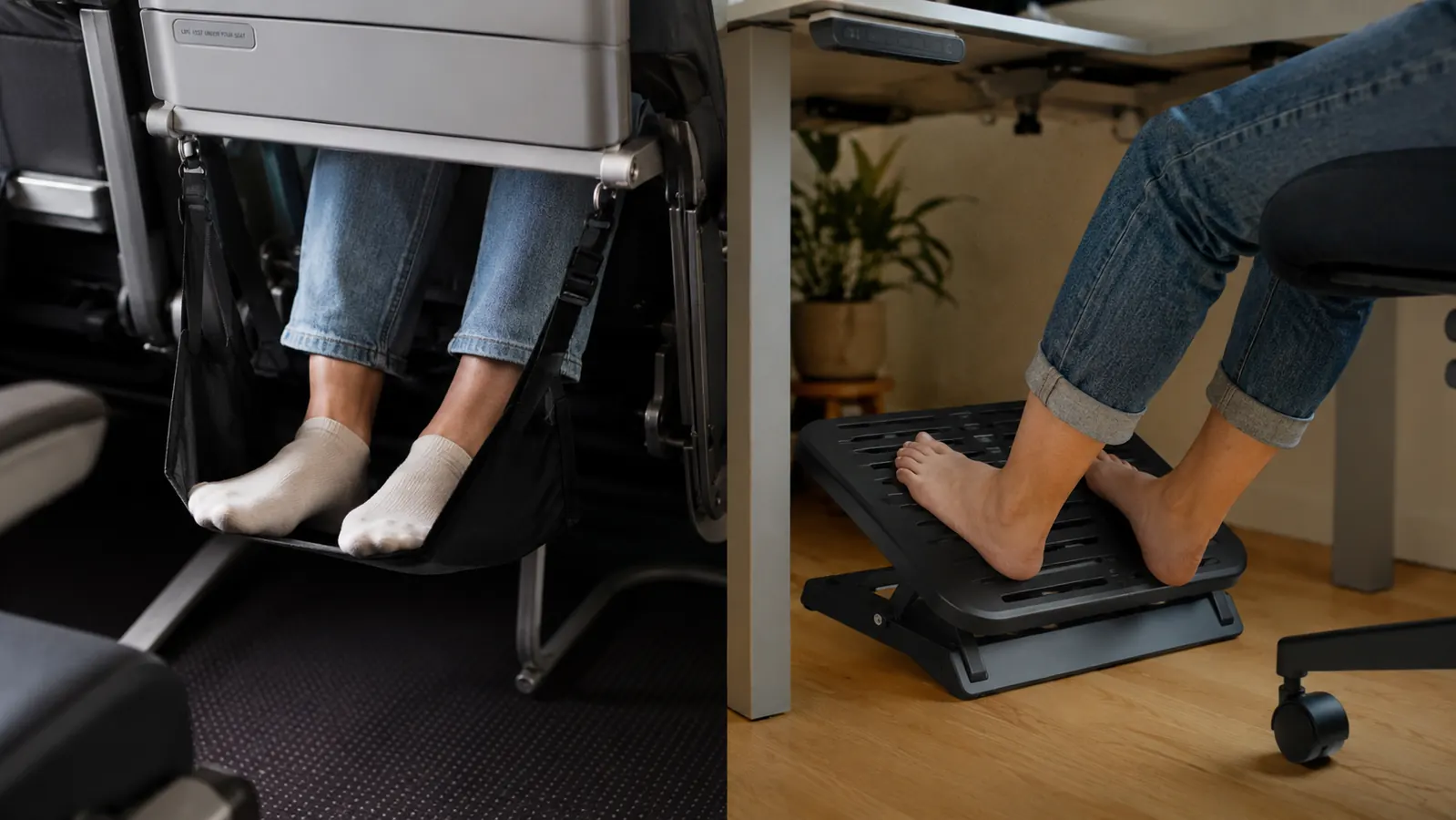
Short answer, since you're probably reading this with your knees jammed against a seatback: for flying, the BASIC CONCEPTS Airplane Adjustable Foot Hammock wins, and it isn't close. I own a rigid desk footrest too, the kind that sits under an office desk and looks like a molded plastic wedge, and I tried bringing it on a trip exactly once before I understood why that was a mistake. That one bad experience is basically the reason this whole comparison exists.
Here's the thing nobody tells you when you buy a desk footrest for your home office and then assume it'll double as travel gear. Those things are built to solve a completely different problem. A desk footrest sits on solid, flat, unlimited floor space and gives your feet a fixed angle to rest at while you type. An airplane seat gives you roughly seventeen inches of width, a floor that's often occupied by a bag, and a tray table leg that isn't going anywhere. The comparison sounds simple on paper, foot support versus foot support, but the two products are engineered for opposite constraints, and that difference is the whole story here.
I want to be upfront about how I'm judging this, because most comparison articles just list specs off two Amazon pages and call it a day. I've flown with the BASIC CONCEPTS hammock on more than a dozen trips, long domestic hops and one nine-hour transatlantic leg, and I've used a standard rigid desk footrest under my home desk for about two years. Both products do what they claim in their intended setting. The question that actually matters for a travel accessories site is narrower: which one survives economy class, and which one is quietly useless the second you leave your house.
| Foot Hammock | Desk Footrest | |
|---|---|---|
| Price (typical, 2-pack) | Budget-friendly for two hammocks | Moderate cost for one rigid footrest |
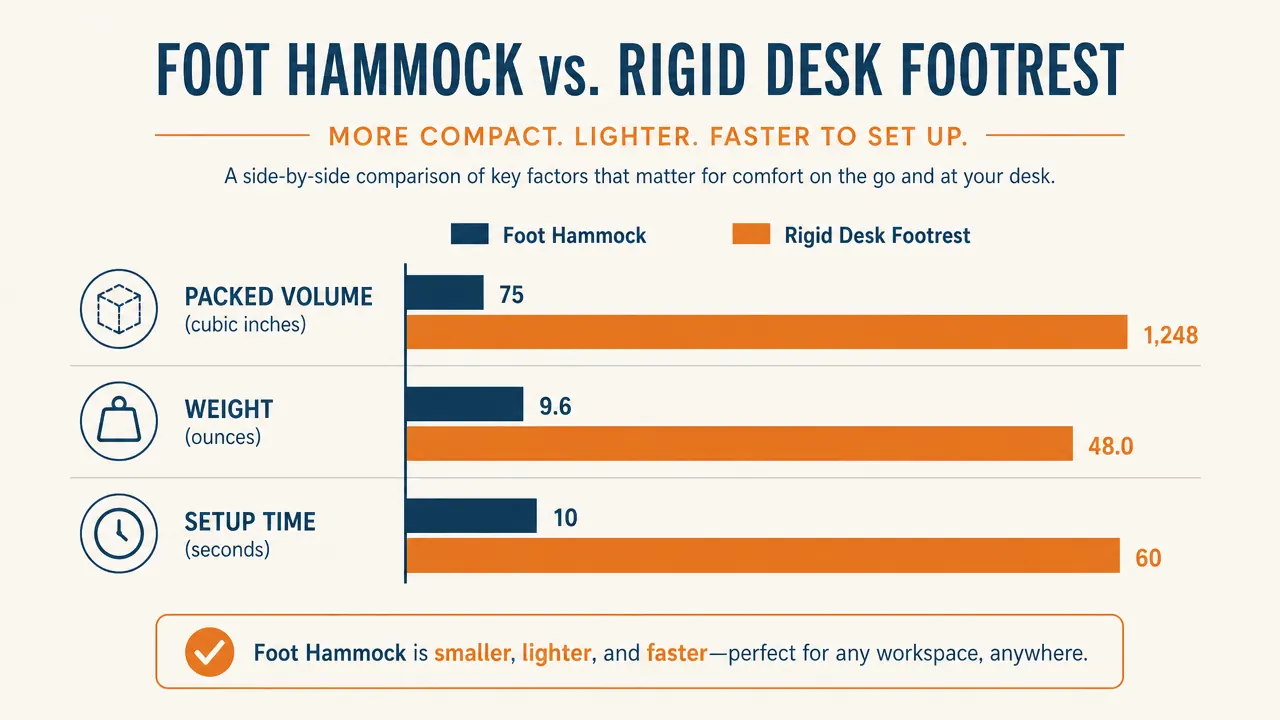
| Packed size | Folds flat to about the size of a paperback, fits a seatback pocket | Molded plastic shell, roughly 17" x 13" x 5", does not fold or compress |
| Weight | 6 oz per hammock | 2 to 4 lbs depending on model |
| Attachment method | Adjustable straps clip around the tray table arm in seconds | Sits loose on the floor, needs open space to stay put |
| Works in economy legroom | Yes, designed specifically for tray table mounting | No, requires floor depth most economy rows don't have |
| Adjustable height | Yes, strap length adjusts to raise or lower your feet | Some models tilt or rock, but height is fixed |
| TSA carry-on friendly | Yes, soft fabric, no restrictions | Technically allowed but bulky and awkward through security |
| Best environment | Airplane, train, bus, anywhere with a fixed table leg or bar | Home or office desk with open floor space |
Where the Foot Hammock Wins
The entire design of the BASIC CONCEPTS hammock is built around one constraint that a desk footrest completely ignores: airplane seats don't give you floor space. The hammock is two adjustable straps and a piece of breathable mesh fabric that clips around the legs of a tray table, then you slide your feet in and adjust the height until your knees sit at roughly ninety degrees. The whole setup takes maybe fifteen seconds once you've done it a couple of times, and it doesn't touch the floor at all, which means it doesn't matter if your backpack is wedged under the seat in front of you. That's the single biggest thing a rigid footrest can't get around. It needs floor real estate that most coach seats simply don't have once your personal item is down there too.
The second win is pack size, and this one is almost embarrassing to compare directly. Both hammocks in the two-pack fold down to something close to the thickness of a folded t-shirt and slide into a seatback pocket or the outer sleeve of my backpack. I genuinely forget I'm carrying it until I need it. A rigid desk footrest, by contrast, is a molded shell. It doesn't fold, it doesn't compress, and if you tried to bring one through TSA you'd be explaining to the gate agent why there's a plastic wedge in your carry-on. I did this exactly once, on a trip early on before I understood the difference, and ended up gate-checking it because it wouldn't fit under the seat in front of me anyway.
Adjustability is the third thing that separates them in practice. The hammock's strap length changes how high your feet sit, so on a flight with less legroom I loosen it slightly and let my feet hang a bit lower, and on a roomier flight I cinch it up to actually take weight off my lower back. A rigid footrest gives you one fixed height, maybe a slight rocking tilt on some models, but you can't adapt it seat to seat. On a plane where legroom varies by six inches depending on the aircraft, that flexibility isn't a nice-to-have, it's the difference between the hammock working at all and just sitting unused in your bag.
See why 10,000+ flyers rely on the BASIC CONCEPTS hammock
Two hammocks, folds flat, clips under any tray table in seconds. Check today's price and current availability on Amazon.
Amazon Check Today's Price on Amazon →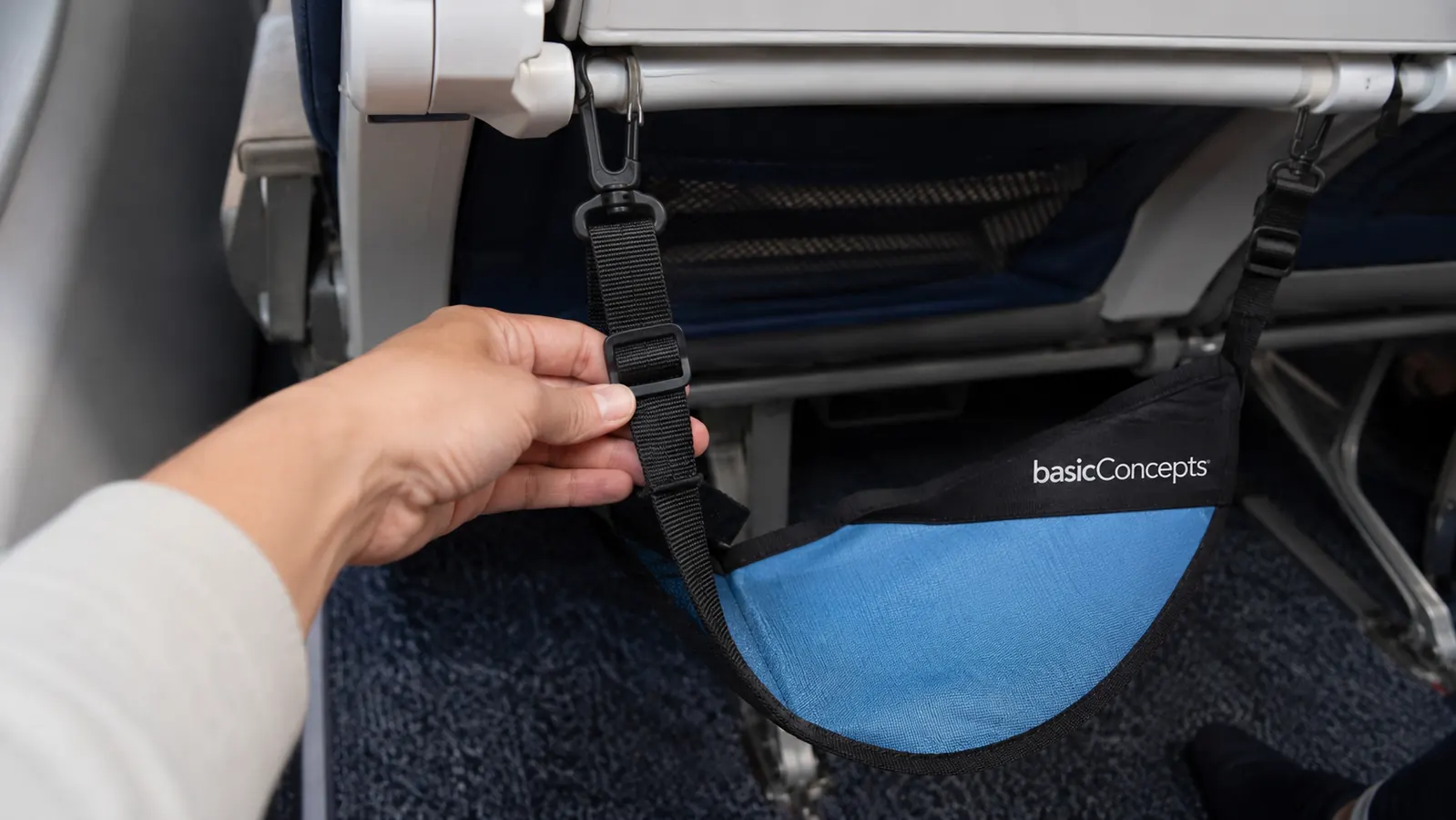
Where the Desk Footrest Wins
I'll give the desk footrest its due, because in the right setting it's genuinely better than a fabric hammock. If you sit at a home or office desk for eight hours a day, a rigid footrest gives you a stable, unmoving surface under your feet that doesn't shift or sway when you adjust your posture. Some models tilt or rock slightly, letting you flex your ankles throughout the day, which a hammock simply can't replicate since it's suspended fabric, not a solid platform. For someone dealing with circulation issues who needs a firm, consistent angle for their feet during long desk sessions, that rigidity is actually the point, not a drawback.
The other place a desk footrest wins is durability under constant stationary use. Because it's molded plastic sitting on carpet or hardwood, it isn't dealing with the wear a fabric hammock takes from being stuffed into a bag, unclipped, reclipped, and washed after every trip. If you never plan to travel with it and it's living under one desk for years, the rigid build is arguably the more durable long-term investment for that specific use case. It also doesn't care about humidity, cabin pressure, or getting jammed in an overhead bin next to someone's rolling suitcase, because it never has to leave the room it lives in.
The desk footrest is a better tool if you're never leaving the room. The foot hammock is the only one of the two that was actually designed for the seat you're sitting in on a plane.
The Legroom Test
I ran an informal test of this on a recent flight, a standard 3-3 domestic configuration with roughly 30 inches of pitch, which is about as tight as economy gets these days without dropping into basic economy territory. I set my backpack under the seat in front of me first, the way I normally travel, then tried to see how a rigid footrest would even fit in the remaining space. It didn't, not without either giving up the under-seat bag storage entirely or wedging the footrest at an angle that made it useless. The hammock, meanwhile, clipped to the tray table arm above all of that and never touched the floor, so my backpack stayed exactly where it was.
This is really the core issue with bringing a desk product onto a plane. Desk footrests assume you control the floor space beneath you, and on an airplane you don't, your seatmate's bag might be there, your own bag is usually there, and the floor itself is often angled or has cabling near the bulkhead rows. The hammock sidesteps the entire problem by mounting above the floor instead of on it. It's a small design choice that ends up mattering enormously the moment you're actually in a coach seat instead of a home office chair.
Comfort Over a Long Sit
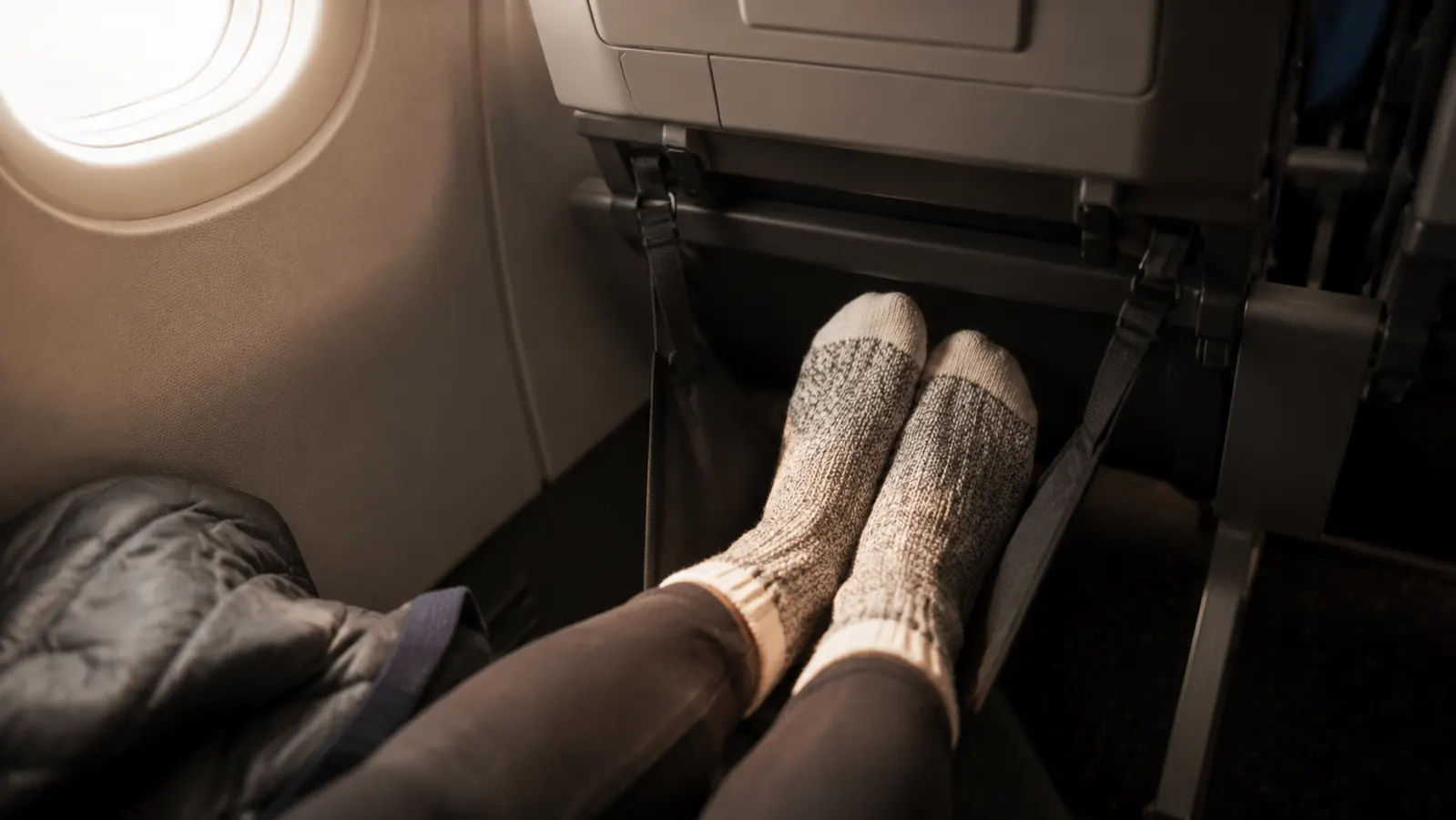
Setup convenience is one thing, but the reason I keep reaching for the BASIC CONCEPTS hammock has more to do with how my legs feel four hours into a flight than how quickly it clips on. The mesh fabric flexes slightly with your feet instead of holding them at one rigid angle, so I can shift position, cross my ankles, or tuck my feet up without unclipping anything. On the nine-hour transatlantic leg I mentioned earlier, that small give in the material was the difference between waking up from a nap with stiff ankles and waking up without noticing them at all. A rigid footrest, whether at a desk or hypothetically on a plane, locks you into one static position for as long as you're using it, and over several hours that rigidity starts working against you instead of for you.
There's also a washability angle that surprised me. Cabin air and long flights are not gentle on fabric, and the hammock's straps and mesh panel can go straight into a mesh laundry bag and get tossed in a normal wash cycle when I get home, which I do every few trips. A rigid footrest just gets wiped down, which is fine for a desk that only ever sees your own socks, but isn't really a fair comparison once you're talking about something that's been under a dozen different airplane seats.
Who Should Buy Which
If you're buying something to solve foot and leg swelling on flights, road trips, or train rides, get the BASIC CONCEPTS foot hammock. It's built for exactly that environment, it packs flat enough to disappear into a backpack pocket, and at roughly twenty-seven dollars for two, you can keep one in your travel bag permanently and never have to remember to pack it separately. The adjustable straps mean it works across different seat configurations, and it doesn't compete with your under-seat bag for floor space, which is the constraint that actually decides whether a footrest is usable on a plane.
If you're furnishing a home office or a desk you sit at for full workdays, a rigid desk footrest is the more sensible purchase, and I'd never tell someone to travel with a foot hammock instead of buying a proper desk footrest for that setting. They're solving different problems even though they get lumped together in searches. The mistake I made, and the one I'm trying to save you from here, is assuming a product built for a stationary desk will translate to a cramped airplane seat. It won't, and you'll find that out the hard way somewhere over Ohio with a plastic wedge you can't use.
For frequent flyers specifically, I'd add one more note. The two-pack format of the BASIC CONCEPTS hammock means you can keep one permanently packed in your travel bag and never have to think about whether you remembered it, while the second stays at home or goes to a travel companion. That kind of redundancy just isn't practical with a bulky rigid footrest, and it's the detail that's kept the hammock in my actual travel rotation instead of becoming another gadget I bought once and forgot about. If you split your time between a desk job and regular flights, honestly, buy both. Just don't try to make one do the other's job.
Stop cramping your legs on long flights
The BASIC CONCEPTS hammock clips under any tray table, adjusts to your legroom, and folds flat enough to live in your bag permanently. See current price and availability on Amazon.
Amazon Check Today's Price on Amazon →